A response to the outgoing prime minister’s first interview since resigning (BBC News, 3 July 2026), addressed to Sir Keir Starmer, to the reporters who will write his first draft of history, and to the man about to inherit his office.
The personal comes first
Listen carefully to how Keir Starmer describes his own departure, because the framing is consistent — and revealing.
In his BBC interview he explains that he “grappled with what was the best thing to do for me, for the country, for the government.” He calls the decision “intensely personal”, not once but repeatedly. It was taken not in Downing Street as a political judgment, but at Chequers, over two days with his wife and children. His resignation rhetoric leaned on the same register: the family man, trying to be a good father, making a private choice.
Any one of these framings, alone, would be unremarkable. Together they form a pattern: at every point where Starmer narrates the end of his premiership, the personal is placed before the public. “For me” arrives before “for the country” — his word order, not ours.
That would matter less if the observable facts supported the story of a private choice freely made. They do not. Starmer repeatedly and publicly vowed to fight on, insisting he would face down any challenger. More than eighty of his own MPs — later reported as over a hundred — called for him to go. He resigned within three days of Andy Burnham’s victory in the Makerfield by-election. By his own admission in the same interview, he was removed because Labour MPs “no longer believed” he was “the right person to take us into the next election.”
A forced political exit has been repackaged as an intimate family decision. Readers can decide for themselves what that inversion — self first, country second, consistently — says about the two years that preceded it. It is, at minimum, a fitting epigraph to them.
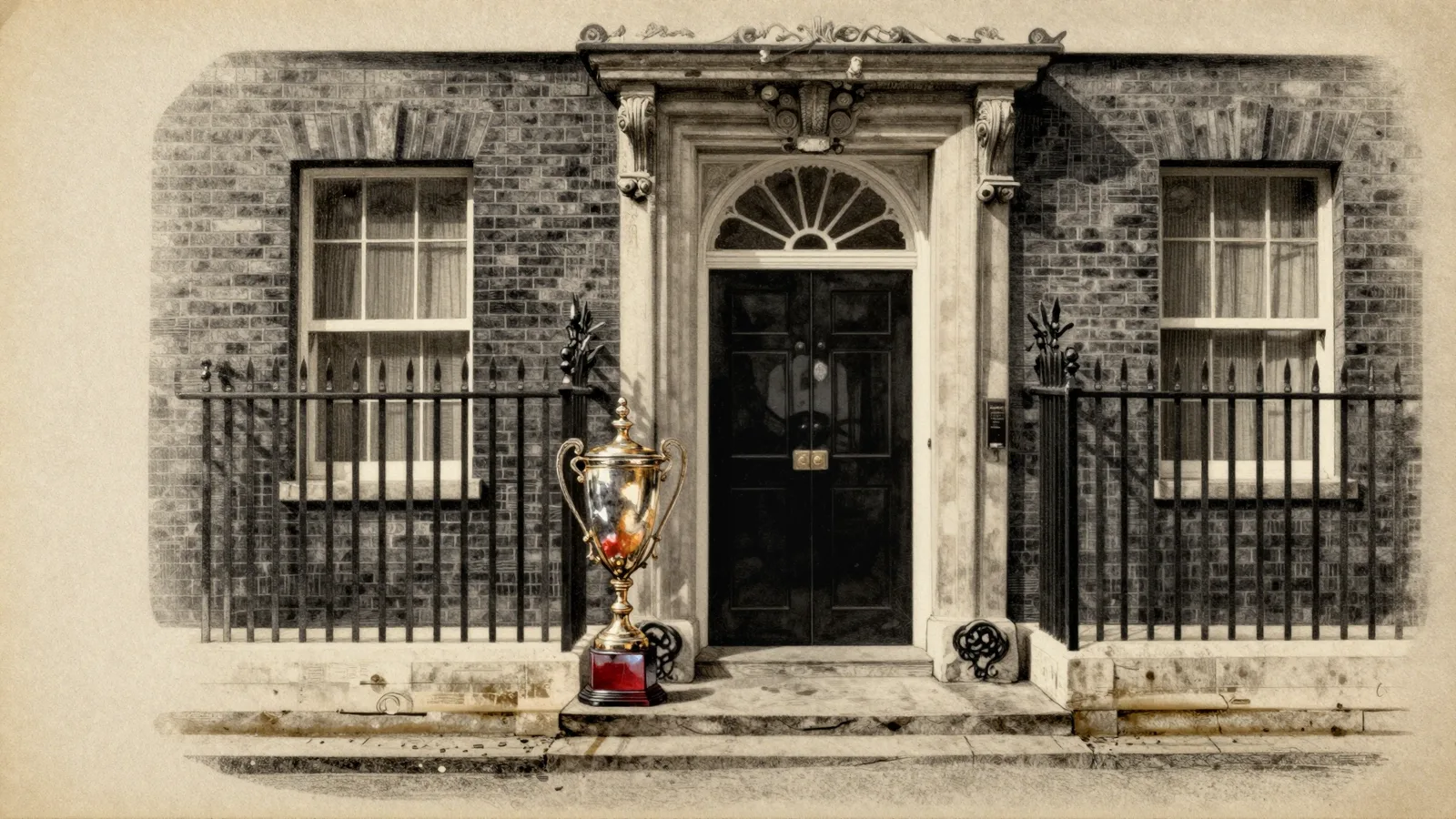
The record: a trophy of a kind
Because there is one superlative Starmer genuinely earned, and it is measurable.
On Ipsos’s satisfaction index — asked continuously since the 1970s — Starmer recorded the lowest satisfaction of any prime minister since the question began: by autumn 2025, just 13% of voters were satisfied with him and 79% dissatisfied. Polling expert Sir John Curtice described it as the worst-ever fall in support for a newly elected government. By January 2026, YouGov measured his net favourability at −57, with 75% of Britons viewing him unfavourably — the joint-lowest score the pollster has recorded for any prime minister except Liz Truss. By February, Opinium put his net approval at −49, below the worst ratings ever recorded for Theresa May, Boris Johnson or Rishi Sunak.
To be scrupulously fair — and this article intends to be — Truss briefly scored lower on some measures. She lasted forty-nine days. Starmer sustained Truss-level numbers for the better part of a year, with a landslide majority behind him and no mini-budget catastrophe to blame. That is not misfortune. That is a verdict.
The company he claims
Which brings us to the most extraordinary passage of the interview. Starmer says his electoral success “should sit alongside” Clement Attlee’s victory in 1945 and Tony Blair’s in 1997.
Take the comparison seriously, then — more seriously than he perhaps intended.
Attlee, in six years, created the NHS, built the modern welfare state through the National Insurance and National Assistance Acts, nationalised roughly a fifth of the economy including coal, rail and the Bank of England, oversaw Indian independence, and co-founded NATO. He then fought two further general elections, winning one.
Blair, in ten years, delivered the National Minimum Wage, Scottish and Welsh devolution, the Good Friday Agreement that ended thirty years of conflict in Northern Ireland, Bank of England independence, the Human Rights Act and Freedom of Information Act. He won three consecutive general elections. And — because fairness demands it — he also took Britain into the Iraq War, a decision that made him deeply unpopular, shadowed his final years in office and stains his legacy to this day. Blair’s unpopularity, note, was purchased by a defining decision of enormous consequence. It is not clear what purchased Starmer’s.
Starmer, in two years, can point to real legislation: the Employment Rights Act, the Renters' Rights Act (its central reform, the abolition of no-fault evictions, in force since May 2026 — though full implementation stretches to 2028 and beyond, long past his premiership), the gradual return of rail operators to public ownership as franchises expire, GB Energy, VAT on private school fees, and the removal of hereditary peers. Abroad: an EU “reset” delivering an agri-food deal and a defence pact at the price of extending EU fishing access to 2038; a tariff-relief arrangement with the United States; a free trade agreement with India.
These are not nothing. They are solid, mid-sized reforms. Not one of them is the NHS. Not one of them is peace in Northern Ireland. And here is the detail that gives the game away: Starmer did not compare his governing to Attlee’s and Blair’s. He compared his winning. Two years after entering office, the election night remains his strongest card — an implicit concession that the record cannot yet carry the names he reaches for. Attlee and Blair won again. Starmer leaves without ever facing the electorate a second time.
What the comparison omits
A fair audit must also count the other column, and it is long. A government elected on “restoring standards” that lost its deputy prime minister to a tax scandal and its ambassador to Washington to a vetting failure over Epstein associations, months after the prime minister’s own gifts-and-freebies controversy. A landslide majority that could not pass its own welfare bill, gutted on the floor of the Commons by over a hundred of its own MPs. A winter fuel cut inflicted on ten million pensioners, then largely reversed after the political damage was done — the pain taken, the savings surrendered. A national grooming-gangs inquiry first dismissed, with those demanding it smeared as jumping on a “far-right bandwagon”, then conceded in full months later. An inheritance tax raid on farms, announced at £1 million, retreated to £2.5 million after a year of rural fury — a policy that critics warn creates pressure on family farms to sell land that larger businesses and institutional investors are best placed to buy, from a government that had signed an investment partnership with the world’s largest asset manager. Asylum seekers still housed in hotels throughout his premiership, against the backdrop of a domestic housing crisis. And a perception — never dispelled, and politically corrosive — of two-tier justice, born in the sentencing rows of 2024, which arguably did more to define him with a section of the electorate than any bill he passed.
On migration, the numbers deserve precision rather than slogans. Net migration fell sharply on his watch — to 171,000 in the year to December 2025, from a peak of 944,000 — though the fall was driven substantially by visa rules his predecessors introduced, and gross inflows of 813,000 remain enormous by any historical standard. Beneath the headline number sits a compositional fact from the ONS that no party has ever put to the electorate: net migration of British nationals is negative (around −136,000 in 2025) and net migration of EU nationals has been negative since 2022, while all net growth comes from non-EU migration (+350,000 in the latest year). These are flows, not intentions, and this pattern predates Starmer. But it continued throughout his premiership without mandate or meaningful debate — and a democracy is owed the conversation.
The financial legacy: still in the red
Starmer’s defenders will point to the economy as the quiet achievement. The honest ledger reads differently.
In his final full financial year, 2025/26, the United Kingdom borrowed £132 billion — a deficit of 4.3% of GDP. Yes, that was the smallest deficit since 2019/20, and fractionally under forecast; his chancellors are entitled to that footnote. But the state he hands over still spends vastly more than it raises, after the largest tax-raising budgets in modern memory — the £25 billion employer National Insurance rise, followed by stealth threshold freezes in November 2025. Public debt stands near 95% of GDP, levels last seen in the early 1960s. Debt interest alone consumed £97.6 billion in a single year — the second-highest cash figure ever recorded. And the new financial year has opened with borrowing already running billions above forecast.
So let this be recorded plainly, because it is the inheritance Andy Burnham — or whoever emerges from the “little bit of process” — actually receives: taxes at a peacetime record, borrowing still at £130 billion a year, debt at sixty-year highs, and a pound in every twelve of government spending going to service old debt. Two years of “hard and bloody work”, by Starmer’s account. The books say the work is not done, and the bill has been forwarded.
To the successor
Starmer’s parting warning to Burnham is that foreign and domestic policy “are one and the same thing” and that no prime minister can spend less time abroad than he did. Perhaps. But the electorate’s warning to Burnham is written in the polling data above, and it says something simpler: a landslide is a loan, not a gift. Starmer borrowed the largest majority this century and returns it, two years later, with the party polling in the teens and his own name a byword for disappointment.
He says he “saved the Labour Party.” His MPs concluded the Labour Party needed saving from him. Both statements appear in the same interview. Only one of them was tested against reality — and reality voted in Makerfield.