Written ahead of Labour’s leadership contest closing and Andy Burnham’s expected entry into Downing Street on 20 July 2026. Sourcing is graded below; corrections are welcome, and factual errors will be amended and noted.
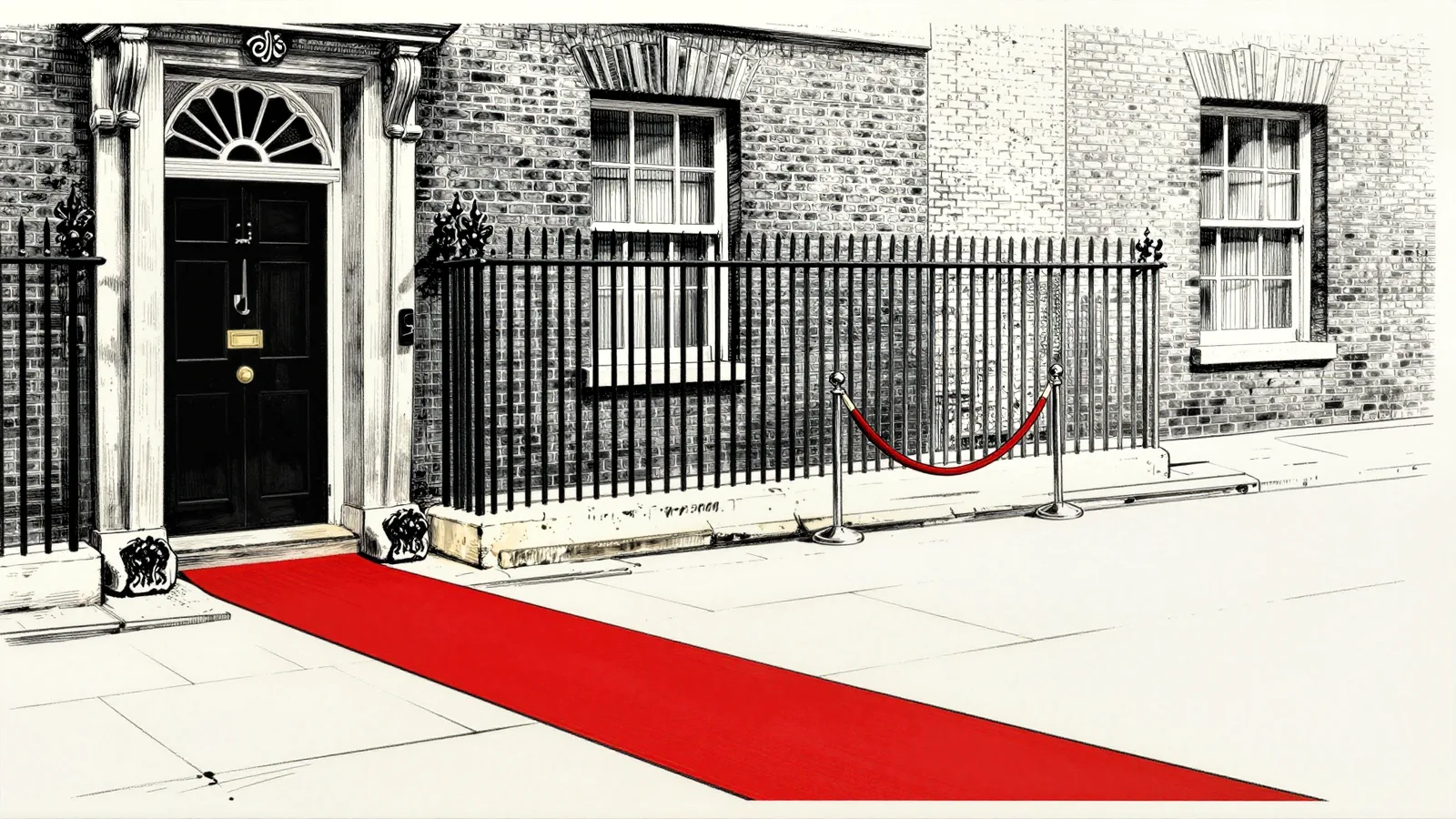
On 20 July, barring a late challenger, Andy Burnham will become Prime Minister of the United Kingdom. He will be the seventh person to hold the office in a decade — and only the second of those seven to have entered it through a general election is a sentence no one can write, because the number is two out of seven, and Burnham will not change it. Asked on Reddit whether he would call an election, he answered with one word: no.
Let us concede the strongest counter-argument immediately, because it is real. Britain does not directly elect prime ministers. Mid-term handovers are constitutionally routine — Brown, May, Johnson, Truss, Sunak. Rishi Sunak governed for two years without ever winning a national vote. Nothing about Burnham’s route to No 10 is improper.
But “constitutional” and “tested” are different words. Labour spent years attacking the Conservative leadership carousel as government by internal appointment. When Keir Starmer resigned last month, some commentators noted the awkwardness of Labour now managing the succession in-house rather than going to the country. The party that ran against the revolving door is about to spin it — and the man stepping out of it has committed to governing until as late as 2029 on the strength of one by-election.
The mandate
That by-election is worth examining, because it is the entire evidentiary basis of Burnham’s claim to public support at the ballot box. He won Makerfield handsomely on 18 June — 55% of the vote, a majority of more than 9,200 over Reform UK, exceeding every published poll.
Three caveats sit beside that result. Makerfield is historically safe Labour territory, next door to the Leigh seat Burnham held for sixteen years. The candidate was the most recognisable politician in the party, polling for over a year as Labour’s most popular figure. And his principal opponent fought the entire campaign with its leader under formal investigation: the Parliamentary Commissioner for Standards opened an inquiry on 13 May into Nigel Farage’s failure to declare a £5m personal gift from businessman Christopher Harborne, and the scandal ran for the full duration of the contest. Reform underperformed its local election showing in the constituency considerably.
None of this makes the win illegitimate. All of it makes the win a poor predictor of a general election — which is precisely the test Burnham has declined to take. Whether he could win one remains an open question, and he has chosen to keep it open until 2029.
The manifesto shield
Burnham’s answer to what he will actually do is that he will “work to the 2024 manifesto.” It sounds like humility — continuity, discipline, no personal project. Its practical function deserves a closer look.
Inside the Labour Party, the 2024 manifesto is a shield. Whatever has already gone wrong under its banner — and by the time Starmer resigned, two-thirds of Britons viewed him unfavourably — belongs to the previous management. Whatever goes wrong next can be filed under inherited commitments. A leader who authors no programme cannot be judged against one.
But the shield only works indoors. At a general election, voters do not apportion blame between Labour leaders; they judge the Labour government, whole. “Starmer did it” is a defence available to Burnham in party meetings and nowhere else. In 2029 he will own every year of this parliament, including the ones he spent explaining that the plan was somebody else’s.
What of his own additions? To be fair to him, he has confirmed positions: he will keep the pension triple lock, keep the fiscal rules, keep the pledges not to raise VAT, income tax or national insurance, seek a returns agreement for failed asylum seekers including with Taliban-run Afghanistan, and pursue a closer EU relationship by building on existing work. Notice the verb in almost every item: keep. The genuinely new material is modest — a floated rise in business rates on warehouses to fund relief for pubs and high streets — or deferred, like his support for proportional representation, which he proposes to argue for in the next manifesto. This is continuity dressed as a programme. It may even be sensible. But it means there is, as yet, nothing distinctly Burnham to scrutinise — which brings us to scrutiny.
The scrutiny gap
Since announcing his leadership bid, Burnham has given one media interview. His major public engagement was a Reddit AMA — a format in which the candidate selects which questions to answer. When Kemi Badenoch challenged him there to face a proper press conference, his reply was that only two weeks earlier he had faced questions from 74,000 members of the public in Makerfield.
Seventy-four thousand is roughly the size of Makerfield’s electorate. It is not the number of people who voted for him, still less the number who asked him anything. An election is not an interrogation; doorstep campaigning is not cross-examination. The figure is a deflection wearing the costume of accountability — and it is the kind of line that goes unchallenged in an AMA, which is rather the point of choosing one.
The gap matters because of what is sitting in his in-tray. Starmer’s farewell Defence Investment Plan promises a £15bn uplift, but the government’s own document leaves £4.7bn of it marked “to be funded at Budget 2026” — source undefined. Burnham has ruled out the three big revenue-raisers and committed to the existing borrowing rules; his only floated tax change funds a different giveaway. So the £4.7bn means departmental cuts, or revenue measures he has not named, within months of taking office. Cuts to what? Taxes on whom? Six weeks from power, he has not said, and the formats he favours ensure no one can press him.
A small note on the coverage, because precision cuts both ways. The BBC reported that Burnham’s chancellor “will have to find at least £4.7bn in savings from other departments.” The government document does not say that; it leaves the funding source open. The BBC’s phrasing adopts the outgoing government’s framing — Starmer described the plan as funded by reallocating departmental spending — and presents as settled what the paperwork explicitly defers. Readers should check documents against reporting. So, more to the point, should reporters.
The operation
None of the above happened to Burnham; all of it was built. The record of how — assembled largely from participants speaking on the record — describes a professional operation, and an admirably candid one.
The money moved first. Between 24 March and 24 April, Burnham received £20,000 from three Labour-affiliated unions — £10,000 from the Fire Brigades Union, £5,000 from the Communication Workers Union, £5,000 from Unison — his first union donations in two years, arriving before any declared campaign existed. All three unions then publicly called for Starmer to set out his departure.
The seat came next, and the provenance is striking. Josh Simons, who resigned Makerfield on 14 May to let Burnham “come home,” previously chaired Labour Together — the organisation widely credited with installing Keir Starmer as Labour leader. Simons denies any plot, saying he and the mayor simply discussed politics over a pint. Take the denial at face value if you wish; the fact remains that the machine which built the last leader cleared the runway for the next one.
The party’s ruling body reversed itself. In February, the NEC voted nine to one to block Burnham from standing in the Gorton and Denton by-election — a contest Labour then lost to the Greens. In May, it endorsed him for Makerfield without obstruction. The single vote in his favour at Gorton had come from deputy leader Lucy Powell, his closest ally, who weeks later told the Fire Brigades Union conference that the leadership would not stand in his way. What changed between February and May, beyond Labour’s local election collapse, has not been explained.
And the coordination was simply admitted. The Spectator reported, from Burnham’s allies, that three operations ran simultaneously from a garden in Golborne before the by-election was even won: the campaign for the seat, the campaign to line up MPs, unions and donors for the leadership, and the planning of a Burnham government. The people involved were not hiding the choreography. They were proud of it.
The timing, too, was chosen, and chosen well. The gambit launched on 14 May — one day after the standards inquiry into Farage opened, two weeks into Reform’s worst period of scrutiny, immediately after local elections had made Starmer’s position untenable. To be clear about what that is and is not: the Farage story was months old by then, the referral to the Electoral Commission came from the Conservatives, and the May pile-up is fully explained by the local election results setting everything in motion. There is no hidden hand here. There is something more instructive — a team that read the board correctly and moved at the moment of maximum advantage. That is what competence looks like. It is worth remembering that the same competence is now aimed at governing without interruption until 2029.
One question the choreography leaves open. Leadership campaigns cost money — staff, polling, communications, three simultaneous operations. The donors being lined up in that garden will eventually appear in the registers, but disclosure runs on a slower calendar than a contest that may end on 16 July. Burnham may well be Prime Minister before the public can see who funded the campaign that made him one. Nothing in that sentence alleges wrongdoing. It merely notes that the answer arrives after it stops mattering — and this site will report the declarations when they land.
What would change the assessment
This piece argues a pattern, not a destiny, so honesty requires stating what would break the pattern. An early economic programme with measurable commitments of his own. Regular, open press conferences. A willingness to say, before the autumn Budget, where the £4.7bn comes from. Any of these would be evidence of a leader submitting to tests rather than scheduling around them — and this site will report them if they come.
Until then, the record shows a politician who declined an election he might not win, adopted a manifesto he did not write, restricted scrutiny to formats he controls, and reached Downing Street through an operation his own allies describe with pride. Each step defensible. The pattern, undefended — because no one has yet been in a room where he had to defend it.
That, in the end, is the point.